I was born in 1975, so this graph really hit home. What does it show? A rising tide does not lift all boats — just the yachts of the wealthy.
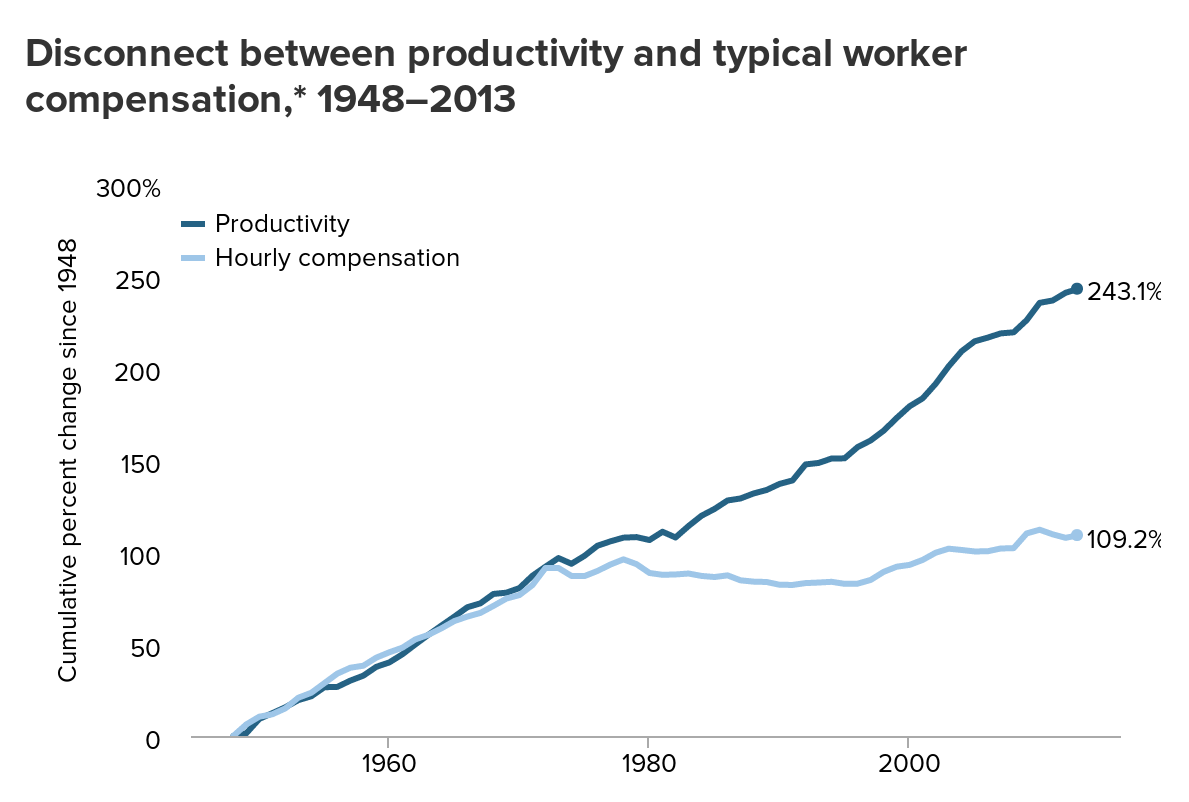
As you can see, worker productivity — the measure of how much goods and services the average worker can produce per hour — has continued a steady climb since 1948. With the introduction of computers, automation, air travel, the internet, etc., workers are able to do much more in an hour than they used to.
But what’s this? Round about the year of my birth, the average worker’s compensation began to stall out. When my parents were growing up — 1948-1973 — productivity rose 96.7%, and hourly pay kept pace, rising 91.3%. Productivity gains were passed on to workers, in the form of increased pay. But in my generation — 1973-2016 — productivity rose 73.7%, while worker’s pay rose only 12.3%.
And what about college grads? Is this trend all about workers who are stuck in a declining manufacturing sector? Surely workers with higher education are fairing better in our “knowledge economy”? Well, that EPI report also contains this unfortunate graph:
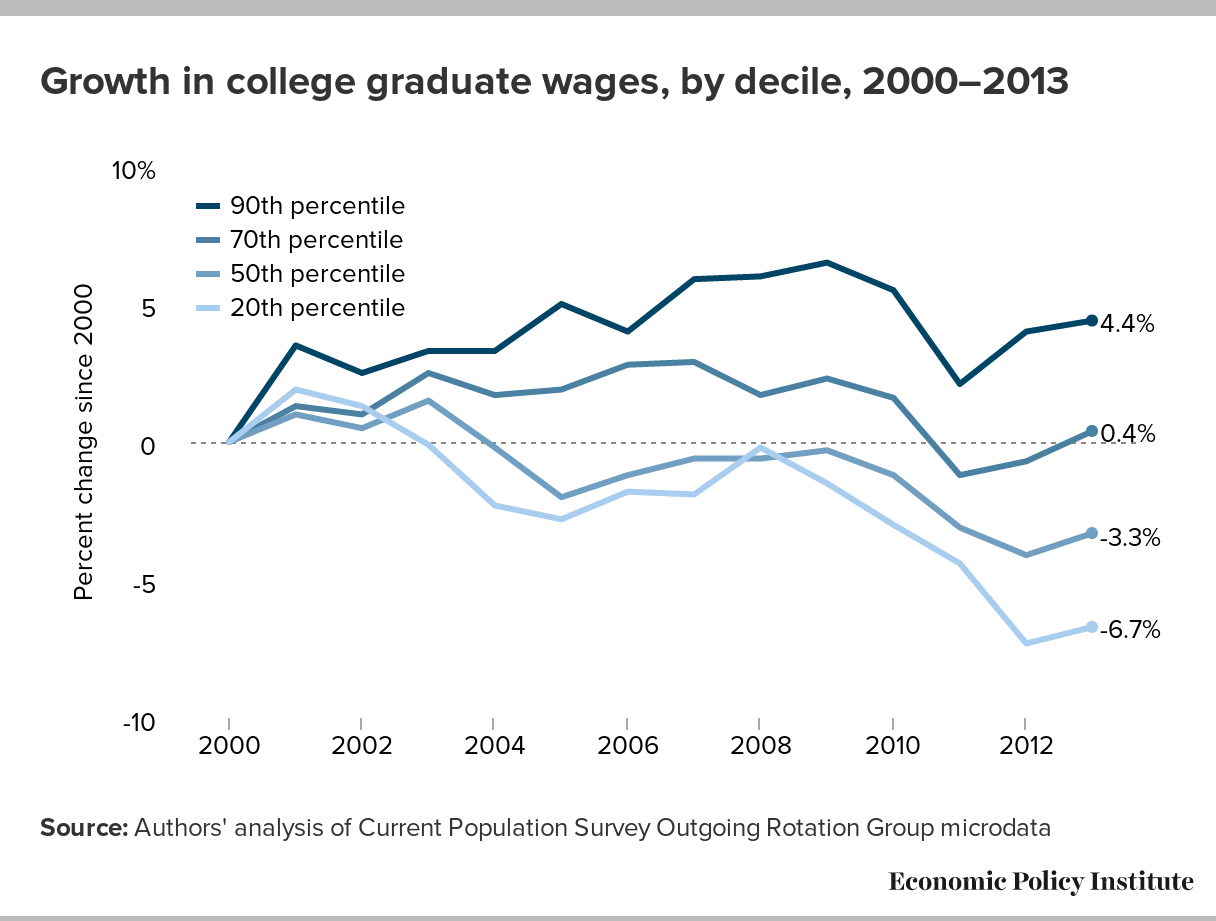
As the EPI report concludes: “The wage growth at the very top 1 percent is due to excessive executive compensation and high pay in an expanded financial sector and is not education-related.” The key phrase there is “expanded financial sector”. Let me translate: if, after an elite college education, you went to work in the higher echelons of the big banks — then yes, your pay has increased dramatically over the last 40 years. But it has nothing to do with having a college education, per se.
So who’s been benefiting from these massive productivity gains? What you are seeing is another form of wage theft: American workers today are more productive than ever before, but they are not enjoying the fruits of their labor. Those increases in productivity, since 1975, mostly ended up profiting stock owners and business elite — a small minority of the population.
Keep this information in your back pocket, because it explains a lot of the surface-level noise about immigration and jobs, concerns about trade, and resentment against welfare recipients. Workers intuitively know that the economy is not working in their favor. But they may not know who their real enemy is.
There are some inconvenient facts here for both conservatives and liberals.
(1) Despite what you hear in conservative circles, the real issue is not whether people are willing to “work hard” to get ahead. It is productivity, and the ability of today’s workers to get much more done than in years past. Worker at X-mart may not look like he’s doing back-breaking work, but he’s getting a hell of a lot more done that the average retail worker 40 years ago. Almost all of those gains in productivity, however, are going to people who don’t work — the people who sell stock and cash dividend checks. Those same people are the donor class of the Republican party.
(2) The trend lines have moved — my whole life — in this direction, regardless of which party is in power. Liberals who have tried to manage or reform the market, so as to share prosperity more broadly, have not been successful at increasing hourly wages to match the gains in productivity. (Oh yeah, some of their biggest donors are also big time investors and business people.)
If you’re wondering what caused this divergence in the ’70s (between worker pay and productivity), it basically comes down to this: declining union membership since the 1970s. Those big, traditional unions made their share of mistakes in the past. But unions still have the potential to provide workers the best leverage, when confronting the capitalist class. While wage stagnation is a problem in other advanced economies, in those that still have robust union membership workers are faring better than in the US.
There’s a lot of good information provided in that Economic Policy Institute report, for those who are curious about this topic.
 Micropolitan
Another good one Owen. I wish your essays were in the Cheboygan Tribune—or any rural area paper. Did you see the latest item in Bridge Magazine on poor/working poor in Michigan?
LikeLike
Thank you, Karen. Yes, I saw the Bridge article — which is a summary takeaway of the United Way’s ALICE report. An updated version of ALICE was just released this week. Lots of good information in there about the poor and working poor. It’s fascinating to read, since they break down the data at the county, and even the township, level. Here is the link: https://www.uwmich.org/alice
LikeLike