
[A series of posts which critique common misconceptions about the rural poor and working poor, held by media, politicians, and ordinary citizens.]
It’s the age-old question: if a tree falls in the middle of the woods, does it make a sound? Answer: only if someone calls their legislator’s constituent services aide to complain.
This winter a lot of trees are falling in the woods, but Speaker Lee Chatfield and Senator Schmidt can’t hear a thing.
Enough with the riddles: I’m talking about the situation at Michigan’s Department of Health and Human Services, where applicants are waiting hours on the phone to speak to a human being, and applications are either delayed or going unprocessed. These problems are acute in Northern Michigan, where the DHHS decided to roll out a new trial program beginning in spring 2018: Universal Caseload (UCL).
What is UCL? Instead of having a dedicated caseworker as their primary contact person, DHHS recipients now have their phone calls and cases handled by a “team” of DHHS staffers who answer calls at random. Cheboygan county is now part of a gigantic 12 county region; a caller may randomly be assigned to a caseworker far away in, for example, Manistee. While caseworkers, in the past, were responsible for the clients in their caseload, they are now (under UCL) primarily engaged in completing tasks, and do not track the same clients all the way through the system. It is now much easier for a client to fall through the cracks, and their application to be mishandled.
What began as isolated comments on Facebook about these problems at DHHS, have now been confirmed by the DHHS’ own data: in counties that adopted UCL, only 62% of emergency heating requests (SER) were approved within 10 days, as state guidelines dictate; meanwhile, in non-UCL counties, that percentage is 92%. In addition, phone calls in Northern Michigan and the UP are taking an average of more than an hour before connecting (see Jacob Kanclerz, MIRS Feb. 11, “Calling DHHS in UP? Average Hold Time is 96 Minutes”).
And what is the response of our local state legislators to this ongoing catastrophe, which coincides with an especially brutal winter? Chatfield ‘s office claims that he’s only heard from a few local constituents about isolated problems, and has forwarded their concerns to DHHS. Similarly, Schmidt — in his Cheboygan office hour on Jan. 21 and in his interview with MIRS — has claimed that “he has yet to hear of his constituents going without food or heat as a result, and if they were, he urged them to call his office so he could get it addressed.”
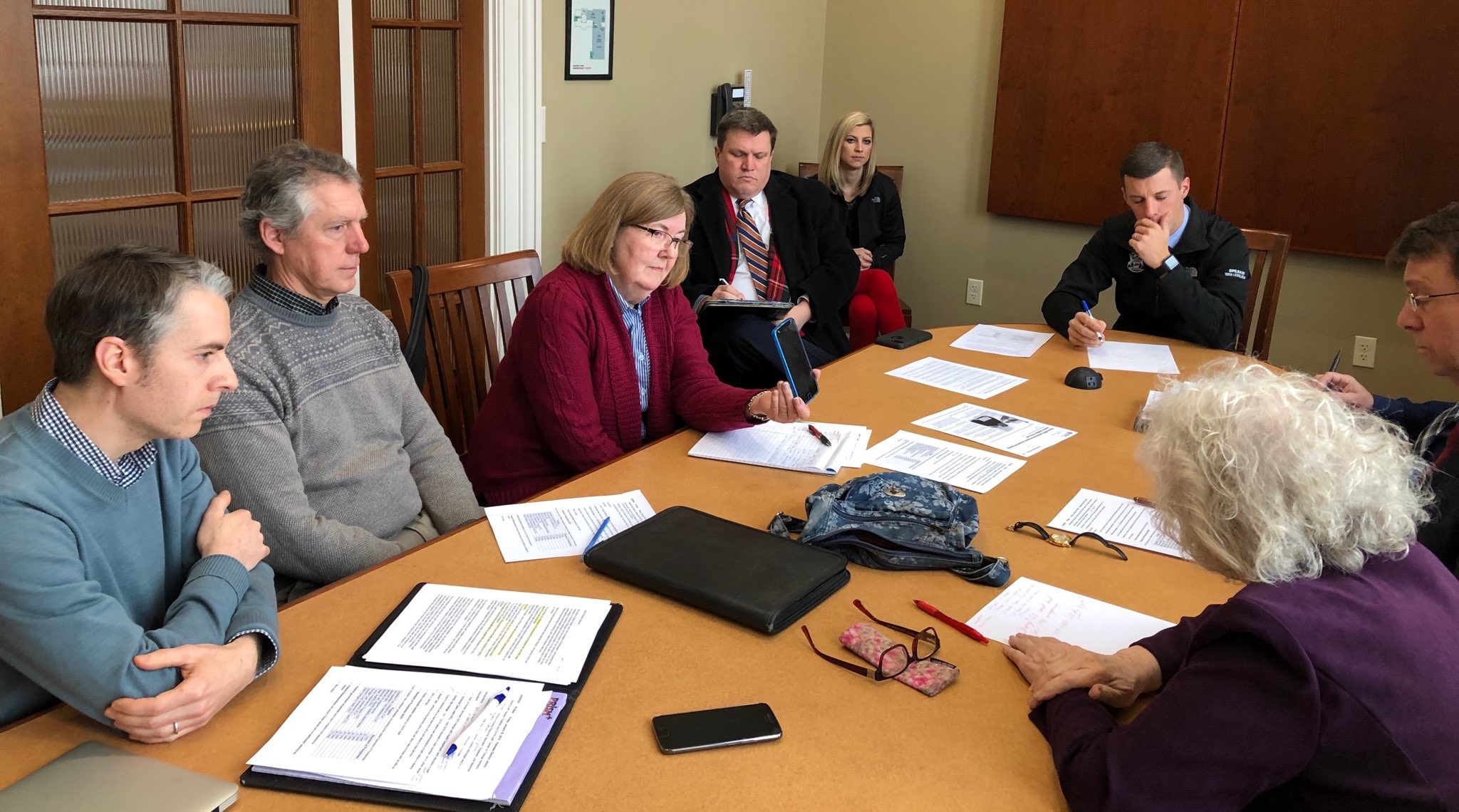
Both Schmidt and Chatfield attended a private meeting in Petoskey on January 25 to learn about these problems. And while they took notes and listened to our concerns, both emphasized that they had heard hardly a peep from their constituents about problems receiving food, heat or health coverage from DHHS. Their reaction could be summed up thus: “Show me who is without heat and food, and I will help them.”
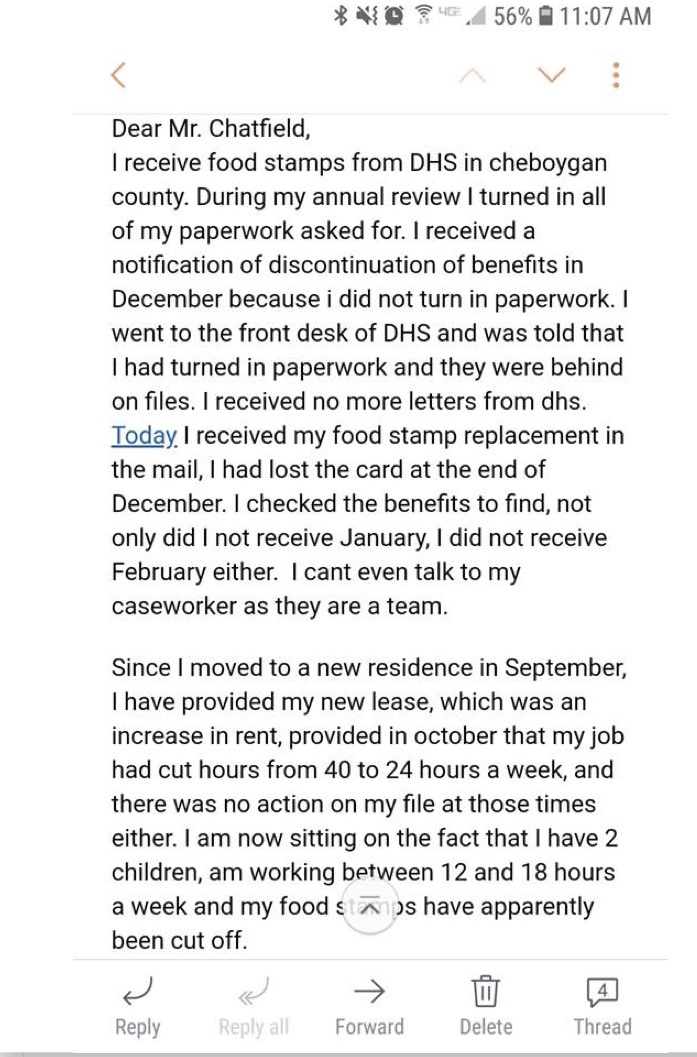
But wouldn’t you know it? A mere half hour before this very meeting, Chatfield’s office responded to a clear, detailed complaint from a constituent who works hard, raises 2 kids, but needs help with groceries. The person did everything right, turned in the required paperwork, but ran into the dysfunction of this year’s DHHS and could not get the assistance that their family deserved:
The following response, sent from the Speaker’s office, was totally inadequate to the seriousness of the problem. Although it’s as short as a tweet, it’s a response that reveals much about the cluelessness of our elected representatives:
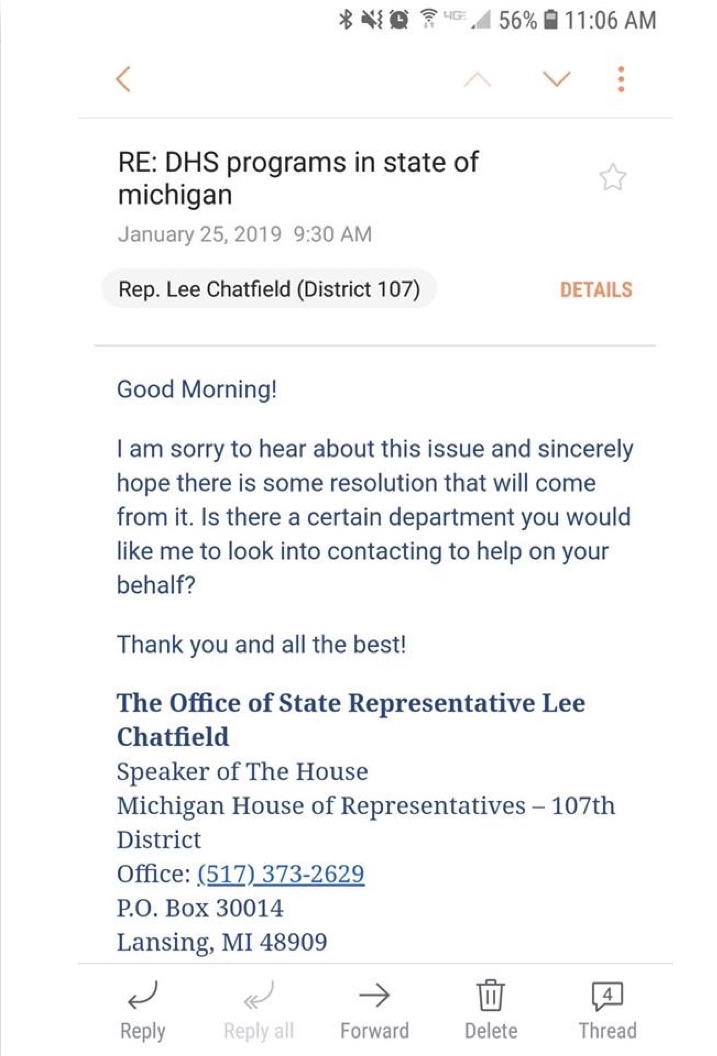
When you read a response like that — which can’t even bother to acknowledge the “certain department” that the letter-writer was clearly criticizing — you have to shake your head and say: They don’t know.
Here’s what Chatfield and Schmidt should know: this letter-writer is very much the exception to the rule. Because duh! Most people do not think to write their representative when they experience problems in their life. Most people are not as articulate with words, as this letter writer is. Most people cannot even name their representative. And I’m not just talking about the poor, though they are more likely to be too busy working to write letters, and too disconnected from political life to lodge a formal complaint with their representative. I’ll use myself as an example: I never wrote a state representative, until last year when I was 43 years old!
Here are a few other facts that our state representatives should know: many people rely on prepaid phone plans, and do not have the luxury of being on hold for over an hour, waiting for basic services. And many people work during the day, and cannot call during the laughably short time frame that the DHHS phone lines are open (9-3:00).
When you read about food assistance cases that stretch into months’ long delays (and when only 35% of applications are processed on time, as in Luce county), you should know that being denied this basic necessity causes chaos in personal lives. Relationships suffer, marriages break up, and other important things go untended to. People may not be literally starving to death, but — isn’t that a pretty low bar in a country as rich as ours?
Chatfield and Schmidt apparently see themselves as some kind of ancient Roman patrons, offering aid and pity only to those poor plebs who petition them one by one. It’s a model of governance that is completely unworkable. The data from DHHS point to systemic problems in our social safety net. These are not isolated pot holes in an otherwise smooth highway of service, but a crisis situation that should have us shouting: “Fix the damn DHHS!”


This is such insightful commentary on the complex challenges of poverty. It’s so much easier to pile blame and scorn on the poor as opposed to truly serving them. I saw a bumper sticker the other day that read: Republicans – working like crazy to support the lazy. It just breaks my heart.
LikeLike
You raise an issue I want to come back to: work requirements for Medicaid are coming to Michigan soon, unless the legislature changes our of Republican control. The assumption is that poor people don’t work hard enough, or have some sort of incentive problem. Yet Republicans never worry about whether the rich are working hard: in fact, their dividends are taxed less than a working man’s paycheck.
LikeLiked by 1 person
Your post is spot on! I particularly liked the comment about prepaid phone plans; Not everyone can afford a smart phone with unlimited minutes; Prepaid phones are common among the poor. The problem with those who hate the poor, is lack of empathy; It doesnt affect them so they simply dont care; The human race can and should do better!!
LikeLike
Yes, our representatives (and other officials who implement these kind of rules) are not very good at imagining the lives of people who are living from paycheck to paycheck. Good policy requires evidence and data, AND a certain empathetic imagination about what that data means for real people’s lives.
LikeLike