Which description fits you: a crazed hillbilly, or a poor suffering individual trapped in a white Christian survivalist family? I hope you said neither. But those are the case stories that Timothy Egan of the NY Times uses to understand the plight of “broken white communities”, in his Feb. 1 column (“A Hillbilly and a Survivalist Show the Way Out of Trump Country“). Poor Egan wants to help us, but he doesn’t have a clue about who we really are!
Where does Egan get this strange idea about the people who live in rural areas? From two recent best-selling books: J.D. Vance’s Hillbilly Elegy, and Tara Westover’s Educated. If you haven’t heard of these authors yet, you will. Both are currently assigned reading on college campuses, where they are discussed by students seeking to “understand” rural America’s support for Trump. Vance recently moved back to his native Ohio, where he is rumored to have political ambitions; meanwhile Ron Howard has plans to turn Hillbilly Elegy into a movie. Vance’s book, in particular, is a noxious take on rural life, which claims that government assistance programs are partly to blame for creating a culture of dependency.
There’s much more to say about Vance at another time, but let’s keep the focus on Egan, a “liberal” columnist who wants to help rural Americans. The fact that he chose these two books, about individual survival and escape, is very much the problem with his argument. Extreme life examples, such as the ones described in these books, rarely make good case studies on which to understand a wider cultural phenomenon.
Here’s the problem: Egan’s argument assumes that these rural communities are broken, and will likely stay broken. Escape is the only remedy offered. As he points out, public institutions — the military and the university — allowed both writers to escape their backgrounds, and find notoriety as acclaimed authors. For Egan, this suggests that education, in particular, is the key to lifting poor whites out of poverty. Of course making higher education available to more students, through tuition support, is a worthy goal.
But what about those rural residents who like their communities, want to make them stronger, and want the resources to do so? In short, what about the micropolitans? Some of the most talked about legislative proposals in 2019 would go a long way towards revitalizing rural America, if enacted: the Green New Deal, Medicare for All, a federal jobs guarantee. And yet nary a word about those in Egan’s article.
Egan provides NY Times readers a lazy and flat understanding of rural problems and culture. It is notable that he assumes the “whiteness” of rural America. Readers might never know about the continuing influence of Native Tribes on rural culture, or the influx of immigrants and non-white Americans even in the remotest corners of Michigan. And then what about the diverse immigrant histories of so-called white people: the Finns, the Poles, Irish, French Canadians? You may be surprised to learn that these groups were not always considered “white”.
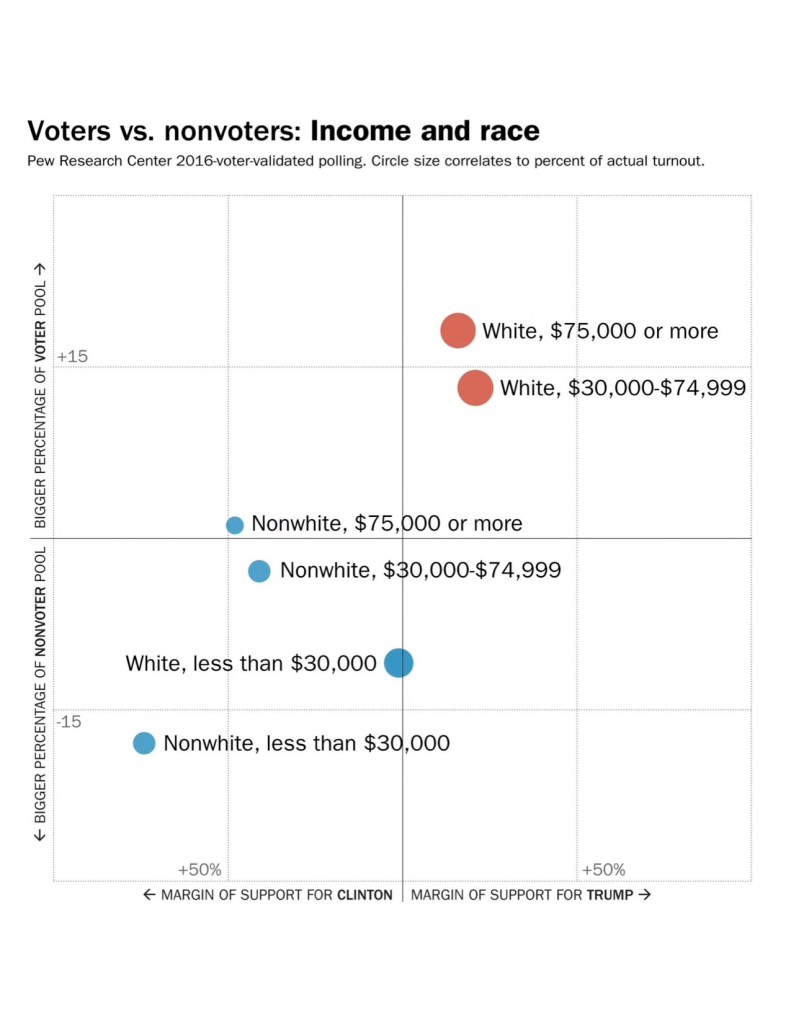
I single out Egan’s article because it is so egregious, but he makes another error that is all too common in other articles about “Trump country”: that is the assumption that the 16 million whites living in poverty are “among Trump’s strongest backers.” That this lazy argument continues to be made in 2019 is amazing, and speaks volumes about liberal assumptions. “Only poor, desperate fools could have voted for Trump!” is the thought underlying many a liberal op-ed article.
Fools, maybe. But poor? Not quite. As a Washington Post article from last August 9 made clear, whites making less than $30,000 per year voted for Clinton. It was middle and upper class whites that put Trump in the White House, and low voter turnout, especially among the poor. As it turns out, the white poor who did vote had better BS detectors than their more affluent neighbors.
But if we’re talking about whites living in poverty and their political impact, we can’t ignore this more basic fact: poor people of all races are much more likely not to vote at all. In Cheboygan county, only 65% of registered voters cast a ballot in 2016. Who are those 35% non-voters? Every demographic study of non-voters indicates that they are much more likely to be poor.
By the way, rural, “white” Cheboygan County voted for Trump in 2016 by an almost 2-1 margin. Obviously it’s a bastion of white xenophobes who would never vote for a progressive candidate of color, right?
Well, fortunately we’ve already run that experiment: in 2008 Barrack Hussein Obama came within 200 votes of winning our county, losing by a mere 0.01% margin. That is less than the margin that voted Green, Libertarian, and other. And it was an election year that saw a slightly higher voter turnout than in 2016.
The saddest thing is when my own neighbors, who ought to remember this recent history, come to accept the glib pronouncements of people like Egan about the place where we live. How many times last summer did I hear people opine that Abdul El-Sayed couldn’t possibly win in Northern Michigan? Whitey, please! We’ve already voted for a fake muslim socialist — is it so hard to imagine voting for the real deal?
 Micropolitan
This is good writing and very insightful.
LikeLike
Thanks, Patti!
LikeLike
Yes, I remember being surprised that it was well off whites that put Trump in the White House; the question is: Why?
LikeLike