This summer Micropolitan visited Japan on a hunch — a hunch that in one of the world’s most densely populated countries, with its highly-developed capitalist economy, we still might find signs of micropolitan life that would intrigue American readers.
It was a task that required help. So the Micropolitan enlisted the services of a half-pint intern who could carry extra boxes of juice and whose cuteness could lure locals into unguarded conversations. And with a combined height of a mere 10 feet, we had no trouble navigating the tight spaces of this overly-populated nation.
But wouldn’t you know it? This intern had ideas of her own and wasn’t satisfied working for animal crackers. While the Micropolitan wanted to learn about local recycling, healthcare, and neighborhood associations, the intern only wanted to go shopping for treats. She zeroed in on the local grocery store with the kid-friendly cart and free treats — the supermarket that’s simply called Co-op.
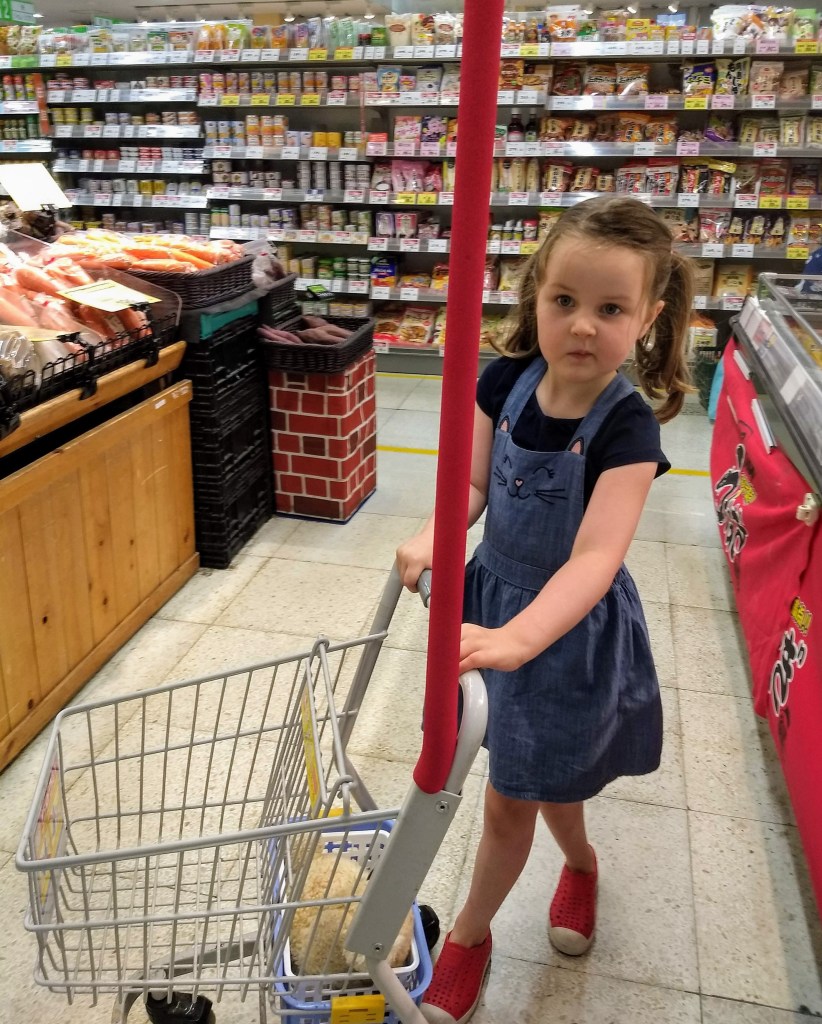
Co-op. Just the name sends me back to memories of the old Grain Train in Petoskey (early ’80s), with its uneven wood floors, weird bulk grains and spicy smells. These days the network of co-ops in the US has grown substantially, and the Grain Train carries most any product your kitchen may need. It’s new location on Mitchell St. is impressive. But the local Meijer and Family Fare are hardly quaking in their boots from the competition.
But the view in Japan is very, very different. Because it turns out that half-pint’s obsession with colorful crackers led us to a remarkable discovery. This full service local grocery store is part of a network of 319 stores across the island nation, with 29 million members — the world’s largest consumer cooperative — and $35 US billion in gross sales. And while the vegetable aisles are stocked with organic, there’s not a whiff of pachouli. This is where Japan’s housewives shop.
In my hometown of Cheboygan — as in many other small towns — the largest food provider is Walmart, a corporation that uses its massive scale and buying power to lower prices for its consumers, and direct billions in profits towards the wealthy scions of the Walton family. The scale of the Japanese Consumers’ Co-operative Union (JCCU) is also big, but the structure is democratic: membership entitles you to vote for the representatives and board who govern this massive organization.
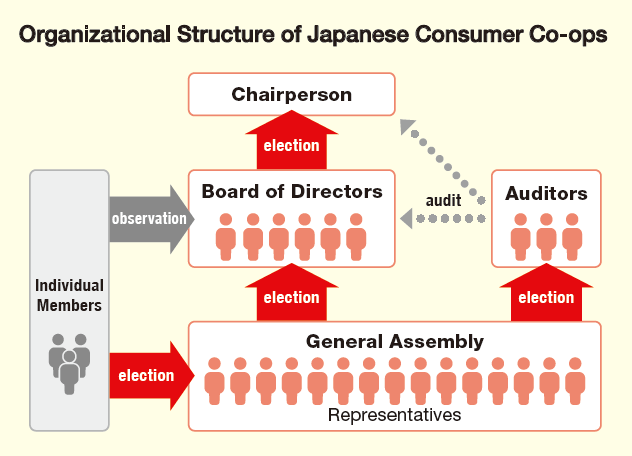
What happens when a corporation is governed democratically, rather than in the interest of the largest share holders? Consider the JCCU’s mission statement: “Creating a more human lifestyle and sustainable society through the concerted efforts of autonomous citizens.” It turns out that groceries are only the tip of the iceberg at Co-op. In addition to food, Co-op provides insurance policies, child and elder care services, and promotes a variety of advocacy causes (especially anti-nuclear and peace campaigns) that influence public policy.
But back to food. Co-op is also the store of choice for my mother-in-law, who has been instructing me in the virtues of organic vegetables for the last 25 years (I am slowly catching up to her and meeting her approval). Like many other aging Japanese, my okasan relies on Co-op for a valuable service: home food delivery, which makes trips to the grocery store unneccesary. And like many other Japanese, my okasan is finicky. (Or, if you prefer, she has a refined palate.) She prefers Co-op because it can provide her the best, freshest organic vegetables from the various regions of Japan.
Perhaps that is why Amazon, which targeted Japan first among foreign markets, has struggled to break into Japan’s home delivery market. Amazon has made multiple attempts to bust the Japanese food market, but it has struggled, despite its technological edge, to gain market share. Twenty years after it first entered the Japanese market, it continues to shop for local partners who can give it a domestic advantage. And yet Co-op succeeds with its paper catalogues — trusted by older consumers — and better selection of food. Although Amazon continues to pose a threat, Co-op dominates the home food delivery market with more than 50% of the market share, and more than a quarter of the Japanese population using their home delivery services. It is hard for an American, who is used to niche co-ops, to wrap their head around that kind of scale.
While the battle between Amazon and Co-op for market share is still unsettled, there’s a lesson for American consumers: the success of the JCCU shows that a corporation that is democratically organized for the social good, rather than for private profit, can be competitive even in the most advanced capitalist nations. It is possible to have our Pocky and our organic vegetables, our economies of scale and local control, while directing the interests of members to campaign for food safety and de-nuclearization.
P.S. our reporters did eventually leave the supermarket and investigated recycling, healthcare and neighborhood associations in Japan. Stay tuned.
 Micropolitan