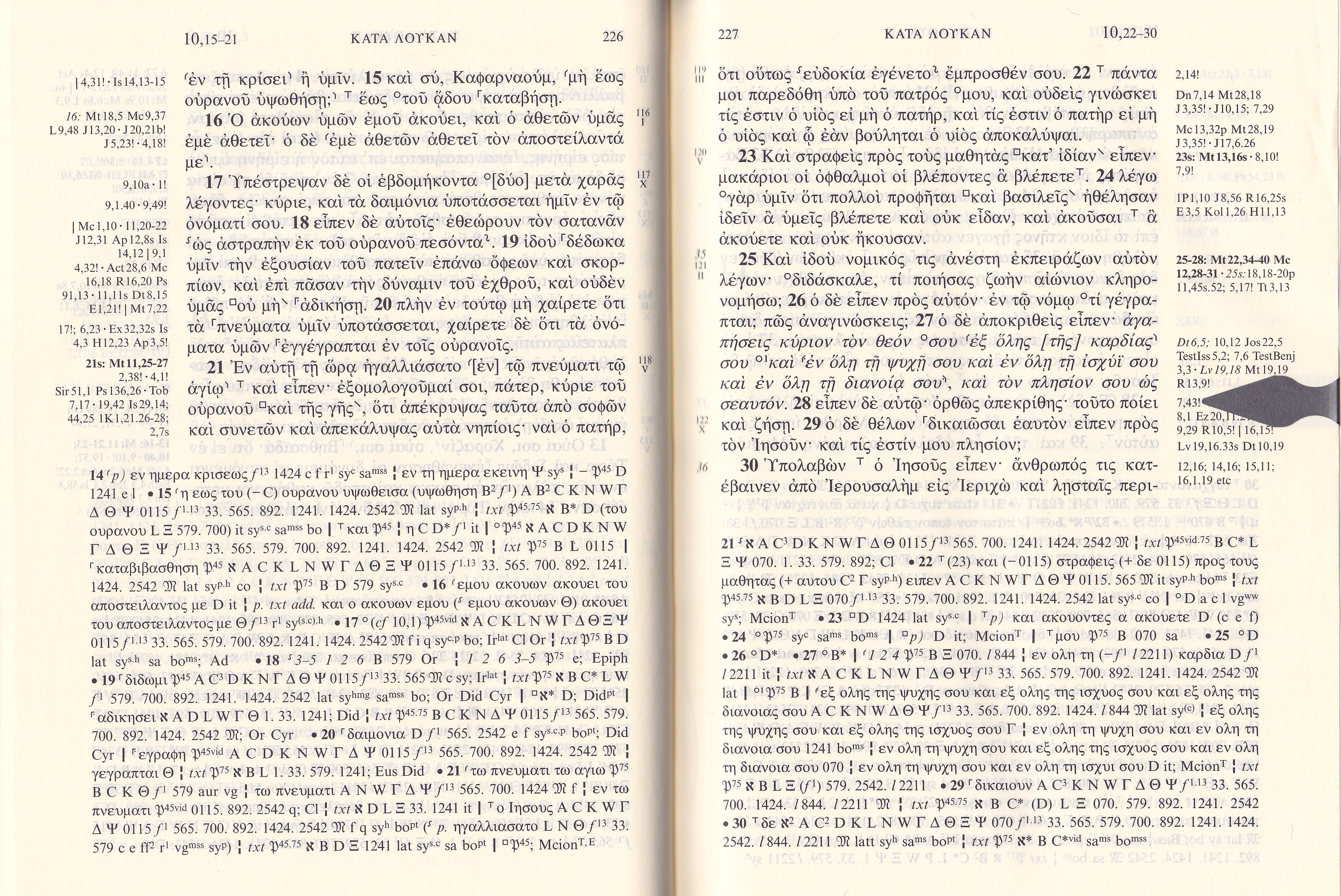
Last summer I started reading the New Testament in Ancient Greek, a few pages at a time. The good thing about reading in Greek is that it forces you to go slow; you really have to work at fitting the pieces of a sentence together to make meaning. As a result, familiar sayings and passages seem fresh. Such is the case with the Parable of the Good Samaritan, which I finally reached yesterday (Luke 10: 25-37). I thought I knew this tale, but I was surprised at what I found.
The setup is important to the meaning of the parable. A lawyer asks: “By doing what” will I win eternal life? Jesus responds that the lawyer already knows, and only needs to recall what’s written: “love God your lord with your whole heart…and your neighbor as yourself.” But lawyers like to quibble over words, am I right? So he asks Jesus a follow-up: “And just who is ‘my neighbor’?”
In answer, Jesus tells the following parable: a man travelling from Jerusalem to Jericho was beaten, robbed, and left for dead in the road by bandits. Along came a priest: he saw the half-dead man, yet kept walking on the other side of the road. Then along came a Levite (a kind of priest’s assistant): he saw the man, but did just as the priest had. Finally a Samaritan passed by: he saw the man and felt a visceral compassion. He cleaned the man up, carried him to a nearby inn, and arranged for an open tab with the inn-keeper, while the man recovered.
Jesus then asks the lawyer: “and who of these three do you think was the ‘neighbor’ to the man felled by bandits?” The lawyer responds: “the one who acted compassionately to him”. Bingo.
There are several interesting things about this parable. First, Samaritans were members of a religious sect hostile to Jews at this time – and vice versa. And they were associated with a region far to the northwest of Jerusalem and Jericho. Thus the compassionate “neighbor” in this parable is not whom you might expect: he himself is a stranger in this neck of the woods, and is not even of the same religious group as the others in the story.
If we were to update this for our times, the Samaritan might be a Muslim immigrant, for instance, who tended a half-dead Catholic whom he found while walking a side-street in Cheboygan.
The second interesting detail in the story is how the meaning of “neighbor” is expanded beyond its normal usage. It emphatically does not just mean “someone living near me”. In Jesus’ telling, a neighbor is anyone who comes in contact with another individual, and feels compelled to act with compassion towards him. The Samaritan not only feels pity for a total stranger, but he acts on it.
In Greek, the connection between the very beginning of the passage, and its final moral lesson is clear, because the same verb is used. Remember, the lawyer initially asked Jesus: “by doing what” will I gain eternal life? At the end of the parable, he realizes the true neighbor is the one who (literally) does pity towards the half-dead man.
Finally, the narrative is an example of masterful teaching. At the beginning of the passage, the lawyer addresses Jesus as a “teacher” (didaskalos), with a question intended to test him. But instead of answering directly, Jesus relies on his new pupil’s ability to draw the proper conclusion from his parable. At the end of the passage, it is Jesus who asks the question and the lawyer who supplies the answer.
Yesterday was the first time I had ever read this parable, though of course I had heard it recounted plenty of times and figured I already knew it. So I was surprised to find that the focus was a bit different than I expected: it is really about who counts as our true neighbors. When you see suffering before you, it’s not enough to feel pity – you must take action. And in taking action, you prove yourself a true neighbor.
 Micropolitan